
District training
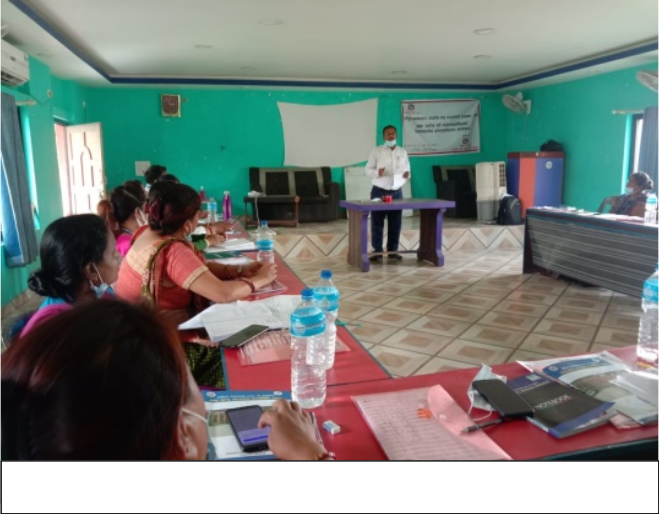
The TL ensured that all training events followed USAID approved COVID-19 Risk Mitigation Plan throughout the
training implementation with continuous monitoring of such
arrangement in all districts through ECs and Logistics support staffs. Kamana Health procured temperature
recording thermal gun, masks, and sanitizers for use in each district training event. It was communicated to each district health office and stakeholders to ensure proposed venue with adequate space requiring physical distance of two meter between two participants and the venue, well ventilated with big sized windows,facilitating cross ventilation and adequate wind flows. Refer to Annex 4 for the COVID-19 risk Mitigation Plan.
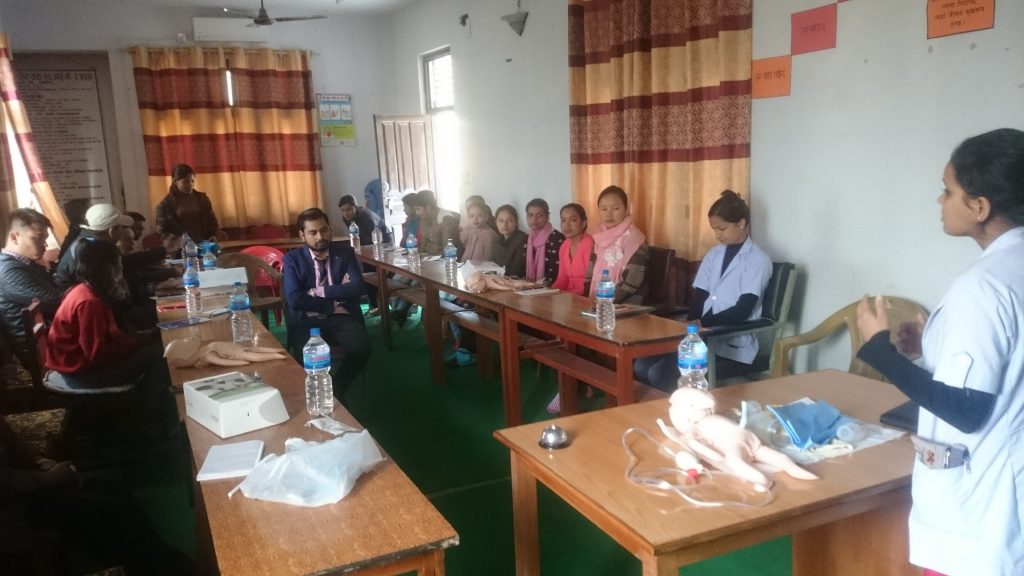
The two days training commenced with the trained trainers facilitating the training event. Kamana Health EC, and the logistics support staff closely supported the trainers for logistics, stationery arrangements and if necessary, facilitated the training sessions by taking the role of an announcer
Other topics dealt, were discussion on VA questionnaire contents, steps of VA, description of maternal death, maternal death causes, and pregnancy related normal and complicated conditions, reasons of abortions during pregnancy. The second day devoted on explanation of
various questions, skills to ask question and filling the forms accordingly. It also covered, pregnant mother’s condition, risk factors during labor, after birth, some possible complications before and during delivery, possible cause of maternal death, utilization of health services. Detail of high-risk pregnant mothers and role of different sector to work for prevention of maternal deaths. The sessions devoted some time to practice VA interviews using a role play method of interaction between an interviewer and a household person responding to the VA questions.
The training in each district was completed in very much participatory approach using interactive methods. The sessions used: discussion of subject matter, presentation, demonstration, role play, quiz, question/answer. Practicum was also used to further hone the skills of the interviewers.
Two trainers facilitated the two days training sessions. At the end of the training, the ECs and logistics support staff distributed training evaluation form to each participant and obtained the filled forms. They compiled each questionnaire and submitted to Kamana Health. They also filled the training completion report, compiled all the forms from the districts and submitted to Kamana Health. At the same time, the team assisted participants to fill the Travel allowance forms, Daily subsistence Allowance (DSA) forms,
computed the total amount for each participant and immediately disbursed the claimed amount. Refer to Annex 2: Training Quality Assurance Plan for the
formats used.
Training in Bajura, Bajhang, Darchula, Doti and Taplejung had to be postponed due to heavy rain that caused landslides and road link to these districts were totally cut off. Thus, training in these districts was completed by 29 October 2021 instead of completing training there by 25 October 2021.
A total of 854 participants were trained in the 77 districts across the country. Out of the total 854
participants, 831 were Female participants and 23 were Male participants (97.31% female
compared to 2.69 % male participants). Province wise number of training participants is
provided in Table 1.
| Province | No. of districts | No. of participants | ||
| Male | Female | Total | ||
| Province 1 | 14 | 1 | 151 | 152 |
| Province 2 | 8 | 2 | 147 | 149 |
| Bagmati | 13 | 9 | 143 | 152 |
| Gandaki | 11 | 10 | 79 | 89 |
| Lumbini | 12 | 0 | 135 | 135 |
| Karnali | 10 | 0 | 81 | 81 |
| Sudurpaschim | 9 | 1 | 95 | 96 |
| Total | 77 | 23 | 831 | 854 |